
Jordana Dambros
Centralizing product data is the daily challenge for anyone involved in marketing within a manufacturing company. Your job isn’t to invent stories; it’s to take technical and commercial reality and transform it into catalogs, price lists, technical sheets, and content for the market. Yet, every day you find yourself transferring information from completely different sources: Excel sheets sent at the last minute, partial extractions from the ERP, technical drawings, sales team emails, and shared folders with improbable names. The feeling? Like navigating blindly in a sea of fragmented information, constantly torn between the anxiety of publishing incorrect data and the frustration of having to start over from scratch.
The Invisible Cost of Fragmented Information
This fragmentation isn’t just about wasted time: it’s the trap where errors are born, product launches slow down, and tensions arise between departments. It’s the classic phenomenon of information silos: isolated pockets of company data where each team adopts its own tool and defends its own “version of the truth.” The technical department guards the technical registry, the sales manager updates price lists on their desktop, and marketing drafts texts in total autonomy. The result? No one speaks the same language.
Why Centralizing Product Data is the Only Solution to Corporate Silos
When systems don’t communicate, problems surface as soon as the company attempts to grow. Teams find themselves swamped by invisible barriers. In daily operations, this translates into incorrect orders because sales and production aren’t synchronized, infinite delays in finding the latest product variant, or the risk of selling models that are already discontinued. The symptoms of this disconnection are all too well-known: long response times for customers, inaccurate inventories, and stressed teams forced to duplicate the same data entry work.
The Cost of Errors on Digital Channels
If we look at digital channels and commercial tools, inconsistent product information generates errors that propagate everywhere: catalogs, website, B2B portals, technical documentation, and commercial offers. If marketing uses obsolete specifications while the technical department updates measurements or features without a shared system, every channel risks communicating different information, compromising the company’s reliability in the customer’s eyes.
Internal Tensions and Slowed Decisions
Without a shared language, cross-department data management becomes a battlefield. Marketing and sales risk contradicting each other in front of the customer, while data is extracted, corrected, and verified multiple times, resulting in enormous time waste. Even management ends up making decisions based on incomplete or misaligned information. When every department updates data in its own tools, maintaining consistent catalogs, price lists, technical sheets, and digital channels becomes increasingly difficult.
The Deterioration of the Work Environment
Lack of communication costs companies millions in lost productivity. Consider the alignment between marketing and sales: a huge portion of B2B content (often exceeding 60%) is never used by salespeople because it doesn’t meet their real needs or isn’t up-to-date. Beyond the economic damage, data dispersion erodes the work environment, fostering a culture of mistrust where more time is spent arguing over which Excel sheet is the correct one than on creating value.
It’s Not the Quantity of Information: How to Centralize Product Data Without Creating Chaos.
Many managers are convinced that the problem is a lack of information. In reality, companies are literally flooded with data. It exists everywhere: in the management system, in PDFs, in emails. The real critical issue is the lack of shared product information. The technical department updates dimensions in a drawing, the product manager manages prices on their file, the customer service collects frequently asked questions on their PC. Parallel sources inevitably diverge at the first modification.
The SKU Code Labyrinth
Fragmentation is also reflected in product hierarchies. Disorganized structures create redundant names, confusion between similar SKU codes, and delays in performance analysis. If marketing launches a promotional campaign using uncodified nomenclature, production planning will struggle immensely to understand which items to standardize and monitor. A coherent structure, conversely, allows for automatic analysis of sales by category, variant, or attribute.
Building a Single Source of Truth
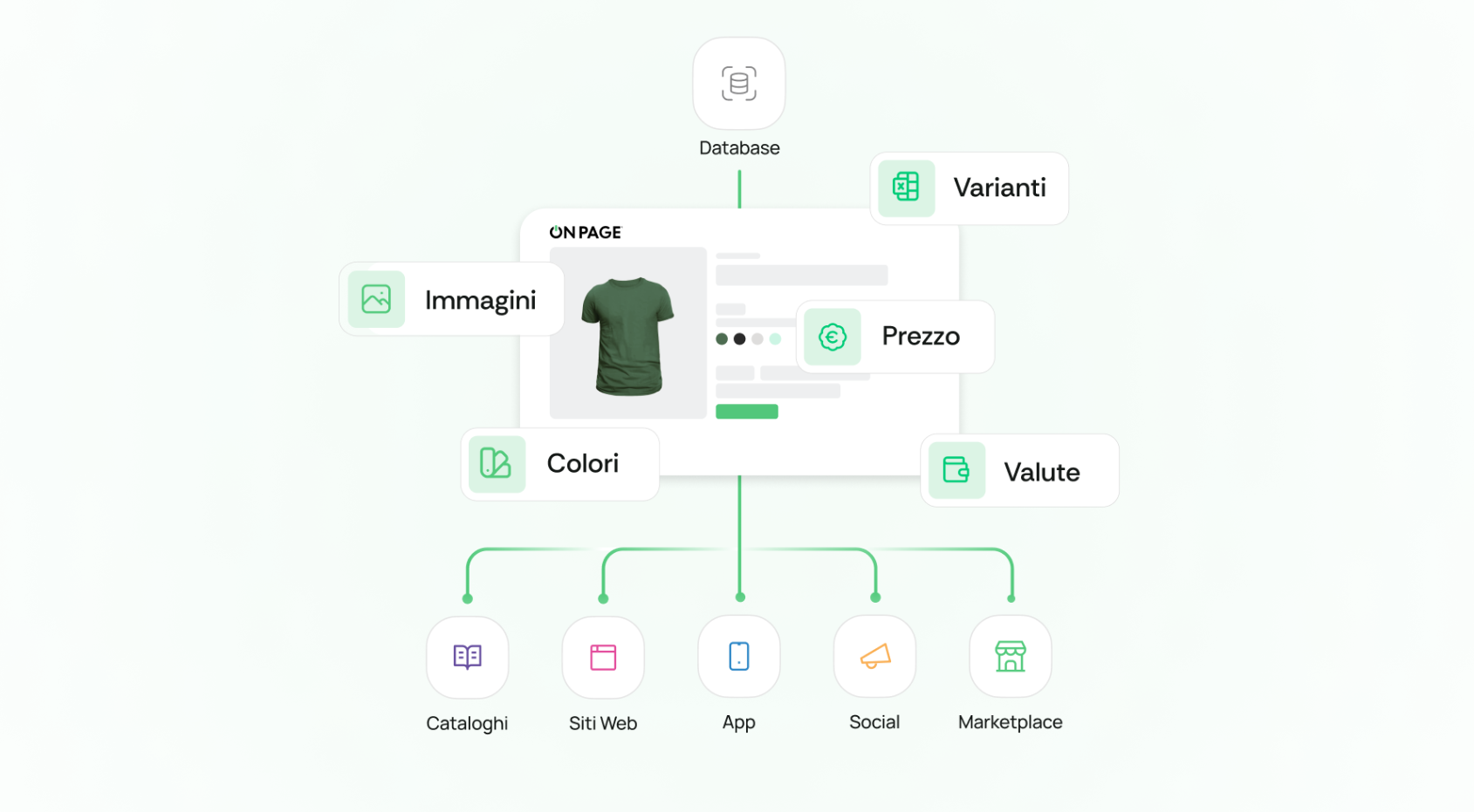
The solution isn’t to add another spreadsheet to the collection, but to choose to centralize information through a process (and a tool) that serves as the single source of truth for the company. A central repository accessible to all departments eliminates duplications and clearly defines who can modify what. The practical benefits change the way you work:
- Execution Speed: The time to produce a catalog or a price list drops to zero. Changes are made once and propagated everywhere.
- Total Consistency: Marketing, sales, and support speak the same language, protecting the brand’s reputation.
- Less Waste: Greater accuracy means fewer incorrect orders and a supply chain that plans based on real numbers.
- Transparency and Innovation: Removing obstacles related to data quality allows teams to collaborate on the product lifecycle, freeing up space for innovation and the development of new solutions.
Operational Strategies for Efficiently Centralizing Product Data.
Moving from shared folders to an integrated system requires a vision that combines organization and technology. It’s not just a matter of software; it’s a matter of method.
- Common Vision: Management must promote shared goals. Breaking down silos primarily means getting people to sit at the same table.
- Standardization: The model comes before the software. It is necessary to define a single structure for classifying products, variants, and attributes, eliminating duplicates.
- Natively Integrated Tools: You need a PIM (Product Information Management) capable of communicating with the ERP and CRM, ensuring automatic flow synchronization.
- Governance and Clear Rules: A system works if everyone knows what to do. Access permissions, approval flows, and defined workflows are needed to keep the information assets clean over time.
Information Assets as a “Competitive Lever.”
The dispersion of product information is not an inevitable tax to pay for corporate growth; it is the consequence of ungoverned flows. Information silos slow down business, generate internal friction, and weigh on margins. Choosing to manage data in a unified way means transforming technical and commercial data into a true strategic asset.
If you recognize yourself in these dynamics and want to understand how to bring order to your company’s product data, the answer is not a new working method, but the right technology.
With the On Page® PIM, you can centralize your entire information asset in a single, intuitive platform, eliminating silos between departments once and for all. Our software integrates perfectly with your business systems (ERP, CRM, and eCommerce), automating flows and allowing marketing, the technical office, and sales to always access updated, certified data, ready for print and digital channels.
Let’s talk: we can help you map your current situation and design a centralization path that truly simplifies the work of every department and protects your margins.

Centralize, update, publish. Without starting from scratch every time.
Discover how On Page® centralizes and synchronizes product information.