Lorenzo Gabatel
A PIM for the furniture industry comes in particularly handy when a simple change to a sofa’s upholstery ends up involving half the company. There’s the catalog to update, the photo to replace, the code to verify, and the price list to correct. And then there are the retailers, who need to receive the right information before offering customers a finish that is already out of production.
Multiply all of this across dozens of collections, each with its own variants, and you get a fairly precise idea of the work hidden behind furniture catalogs.
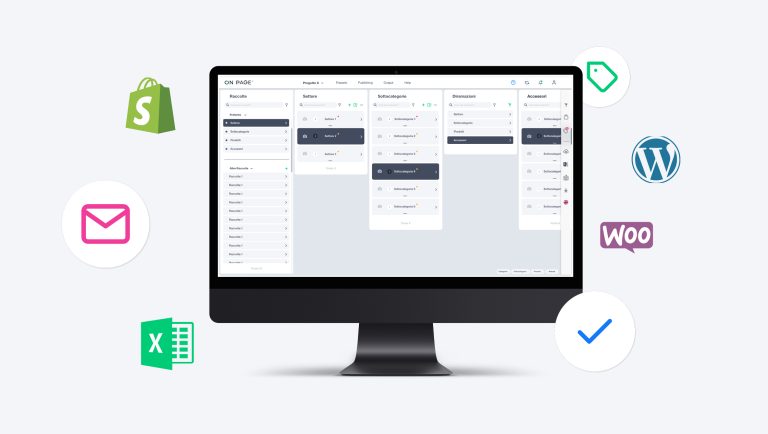
With On Page®, you can manage this information from a single platform and use it to produce catalogs, price lists, and technical documentation tailored for different markets and stakeholders.
PIM for the Furniture Industry: A Single Variant Can Change Everything
Three dimensions, five upholstery options, eight colors. A single sofa can result in up to 120 theoretical combinations, each with specific codes, features, and prices.
Furthermore, each new collection adds complexity to a system that must also account for combinations that are actually available.
With On Page®, you can organize products, attributes, and variants, managing relationships between models, materials, and finishes. When a feature changes, updated information can seamlessly reach connected documents and channels according to your configured workflows.
This makes even the most complex collections easier to manage, eliminating the need to manually edit hundreds of product sheets.
PIM for the Furniture Industry: Catalogs and Price Lists for Every Market
A catalog tailored for an architect includes technical drawings, measurements, and materials. One designed for a showroom emphasizes lifestyle images and customization options. Meanwhile, a German distributor expects a price list in their own language with accurate pricing and codes.
We have three distinct stakeholders with three different needs, yet relying on the exact same core information.
On Page® allows you to leverage this data to generate diverse publications, from commercial catalogs to effective product data sheets.
Thanks to the seamless integration between PIM and Adobe InDesign, product data flows directly into your layouts, greatly simplifying subsequent revisions.
What about price lists? Consider the same collection distributed across Italy, France, and Germany—each with different languages, currencies, and commercial terms. On Page® enables you to manage multiple price lists and customized discounts seamlessly through ERP synchronization.
Every market receives a publication tailored specifically to its commercial requirements, without having to recompile all information from scratch.
PIM for the Furniture Industry: Key Features of On Page® That Make a Difference
Anyone who has prepared a furniture catalog knows that photography is just the tip of the iceberg. Behind every product are renders, technical drawings, 3D models, and finish samples that need to be organized within the correct documents.
On Page® provides dedicated functionality for managing all these media assets efficiently.
DAM: Finding the Right Image for the Exact Variant
The catalog is almost complete, except for the render of the sofa in sand-colored bouclé fabric. Unfortunately, the shared folder contains six files with nearly identical names.
With the built-in DAM in On Page®, high-resolution images, videos, renders, and documents are centrally stored and linked directly to products and their respective variants.
CAD Integration: From Design to Final Documentation
A technical drawing must accurately reflect actual product specifications, including design modifications made during development.
Integration with CAD systems allows you to import models and link them to PIM data, facilitating the production of consistent technical documentation aligned with the project design.
Augmented Reality and 3D: From the Catalog to Real Space
Choosing a dining table from a photo is one thing. Visualizing it inside a room with custom dimensions and finishes provides a far more compelling experience.
Through robust APIs, On Page® powers 3D configurators and augmented reality experiences by delivering accurate data on variants, features, and pricing.
PIM for the Furniture Industry: What Is the True Cost of Updating a Collection?
There is a hidden cost rarely reflected in price lists: the hours spent repeatedly updating the same information across multiple systems.
Hours quickly add up between catalog revisions, replacing photos, checking prices, and correcting data sheets.
How much time does your company spend redoing work that was already completed? That is the baseline for evaluating a PIM solution.
Learn how to create professional price lists for your furniture products in just a few seconds.
FAQ: Catalogs and Price Lists for Furniture Companies
Yes. On Page® enables you to manage multiple price lists and customized commercial terms using the same underlying product data for publications targeted at different retailers and markets.
Through integration with On Page®, you can automatically update layout data to minimize manual corrections. A final layout review remains recommended prior to publication.
Yes. On Page® integrates with your ERP to import and synchronize key information such as product codes, pricing, and availability according to your configured workflows.
The PIM organizes finish families and associates them with corresponding products. Updates propagate automatically to catalogs and connected sales channels, avoiding separate manual updates.
A PIM allows you to link finish families directly to each product. If a fabric is discontinued, updating it once in the PIM automatically removes it from all connected catalogs and websites.
Yes. Thanks to advanced APIs, On Page® seamlessly powers online 3D configurators with real-time product data—including variant names, surcharges, and specifications—enabling end users to customize their furniture effortlessly.
Absolutely. The PIM allows you to handle multiple price lists and customized discount structures, simplifying collaboration across your global sales network.

Centralize, update, publish. Without starting from scratch every time.
Discover how On Page® centralizes and synchronizes product information.