
Jordana Dambros
Product Data Governance is often viewed as a theoretical exercise for an IT manual. However, for a manufacturing company, it is the answer to a daily paradox: how is it possible that all departments use product information, but no one knows for sure who is responsible for maintaining it over time?
Let’s set the technical jargon aside. In many industrial realities, the problem rarely stems from software that doesn’t work or an obsolete database. The true bottleneck is purely organizational, emerging when trying to understand who manages product information along the internal supply chain, preventing the company’s information assets from fragmenting into a thousand different directions.
From theory to practice: how data fractures in the field
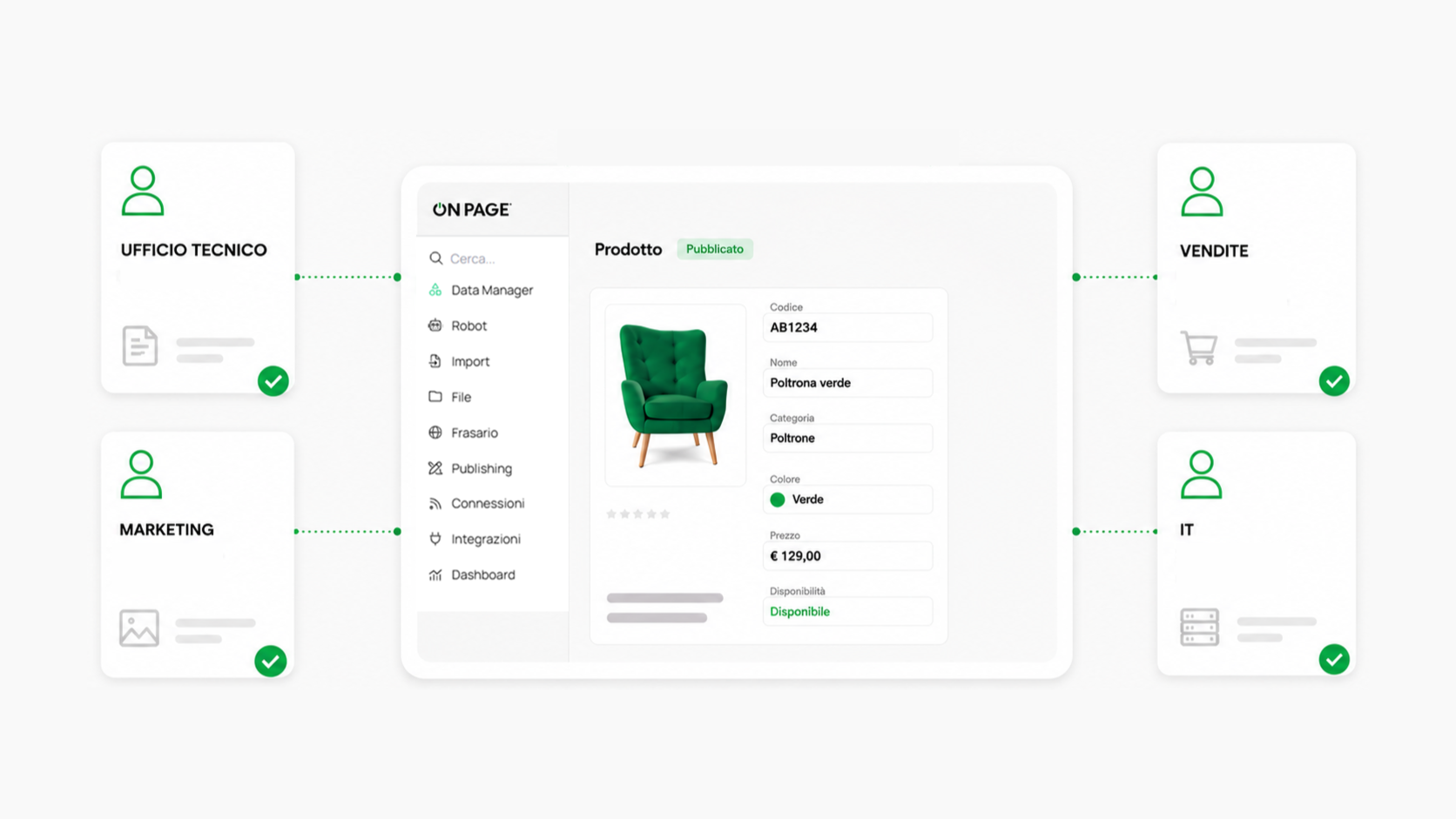
- The technical office creates codes, variants, and tolerances with the precision of a surgeon.
- Marketing takes that block of raw data and tries to transform it into something human beings want to read (and buy) on a website, an e-commerce platform, or a commercial datasheet.
- IT acts as a human shield for the infrastructure, ensuring systems stay up and data flows are secure.
- And the sales team? They need to sell, so they often create their own “quick and easy” version in a local file to answer the customer in three seconds flat.
Everyone touches that product information, everyone modifies it, and everyone enriches it. But when something goes wrong, the ownership of that information vanishes into thin air.
This is where Data Governance becomes a central theme for manufacturing companies: not as an abstract concept, but as a method to establish responsibilities, update rules, and processes for constant maintenance.
Why the lack of product information governance triggers departmental wars
When product information lives in Excel files, shared folders, ERPs, paginated catalogs, old PDF sheets, and documents sent via email, each department ends up building its own version of the truth.
Interestingly, they are all right from their own point of view:
- The technical team defends engineering accuracy in the management software.
- Marketing defends readability, commercial appeal, and formatting.
- IT defends system stability and database cleanliness.
- Sales defends speed of response to the market.
Without a shared product data governance, these priorities don’t integrate; they collide. The operational result is predictable: misaligned technical sheets, obsolete images ending up on the website, missing attributes that block sales, and precious hours lost running around the corridors to verify if that code is still in production or not.
Who should be responsible for product information?
The most common temptation in a company is to delegate everything to IT. “It’s a data problem, so IT should handle it.”
In reality, IT manages the infrastructure and the channels through which information travels, but it cannot be the owner of the content. Product information has a hybrid nature: it is technical, commercial, regulatory, and linguistic. To survive, you must clearly separate the strategic ownership of the data from its daily operational management.
- The Data Owner is the individual or department that has final responsibility for the accuracy of a specific area. The technical office is the legitimate owner of measurements and materials: if engineering says a component is stainless steel, that is the only accepted truth.
- The Data Steward, on the other hand, is the person who oversees the quality and completeness of data on a daily basis. Marketing, for example, acts as the steward of editorial enrichment: they take the technical information and accompany it with clear descriptions, commercial naming, high-resolution photos, and correct translations, eliminating narrow company jargon to speak the customer’s language.
Governance works when these competencies collaborate according to explicit rules, not when we hope for the good will or endurance of individuals.
The role of Data Governance in manufacturing companies
In the industrial sector, a product is never just a code with a price. It is a complex ecosystem of variants, compatibility relationships, safety certifications, safety data sheets, destination markets, and different languages. The more this structure grows, the more manual “eyeballing” shows its limits.
Introducing manufacturing data governance logic simply means setting the rules of the game:
- Which attributes are strictly mandatory before declaring a product “ready for publication”?
- Who has the right to modify a specific field and who must approve the change?
- What is the single official data source from which all channels must draw?
Far from being a bureaucratic brake, governance eliminates downtime. When data is governed at the root, marketing doesn’t have to play private investigator for every technical doubt, and sales doesn’t have to hope they grabbed the latest PDF updated on the server.
How to build clear ownership of product information in 4 steps
- Map the existing state: Understand exactly where product information originates, whose hands it passes through, and where it ends up dying (or duplicating).
- Assign ownership: Divide information into logical categories. Prices come from the ERP, specifications from CAD or PLM, persuasive texts and images from marketing. In this sense, dialogue with advanced management systems shows how important it is to clarify from the start which data originates where and who guarantees its updates. Everyone is responsible for their own block.
- Define approval workflows: Establish a rigid path. A new code cannot land in the catalog or on the site until the minimum fields required for sale (measurements, weight, description, translation, etc.) have been completed.
- Centralize the source: Theoretical rules are not enough if tools remain fragmented. You need a single management point where information is centralized, enriched once, and automatically distributed to all sales channels.
From internal governance to digital distribution of product information
At this point, the digital ecosystem in which that information must live also comes into play. Defining responsibilities, workflows, and official sources is fundamental, but it is not enough if websites, e-commerce, digital catalogs, and sales tools continue to draw data from different sources. This is why collaboration with specialized technology partners, like Hostinato, becomes precious when designing digital environments capable of receiving, integrating, and distributing always-updated product information.
A well-governed PIM, connected to web platforms and e-commerce built with solid integration logic, allows for maintaining consistency between what the company knows, what it publishes, and what the customer sees.
Mistakes to avoid to ensure your efforts aren’t wasted
- Thinking it’s a one-off project: Product information is living matter. It changes with regulations, suppliers, and markets. Governance is a continuous process; it is not spring cleaning to be done once a year.
- The totalitarianism of a single department: If only the technical office writes the rules, the catalog becomes a workshop manual that is unreadable for customers. If marketing decides everything, you risk publishing commercial promises that are technically impossible to produce.
- The illusion that “AI will handle it”: AI tools are extraordinary for speeding up the writing of variants, summarizing sheets, or optimizing translations. But AI works on the information it receives: if the starting data is inconsistent or wrong, the algorithm will only multiply the error at an impressive speed. Human intelligence and data cleanliness always come first.
Bringing order benefits everyone (even company peace)
Product Data Governance is an organizational choice.
It serves to transform dispersed assets into a reliable, updated, and shared source. It serves to reduce conflicts between technical, marketing, sales, and IT departments. It prevents every department from working on a different version of the same product.
For a manufacturing company, governing data means making it easier to publish catalogs, update product sheets, open new channels, prepare multilingual content, and better support sales.
The real question, therefore, is not just “what system do we use?”, but “who is responsible for product information and how do we keep it alive over time?”.
If data in your company is still distributed across files, departments, and non-aligned versions, it is time to build clearer governance.
Frequently asked questions about Product Data Governance
What is Product Data Governance?
It is the set of rules, responsibilities, and processes that define who creates, updates, approves, and distributes product data within the company. The goal is to ensure that all departments always work on correct, updated, and consistent information.
Who should manage product information in a manufacturing company?
There is no single department responsible for all information. The technical office manages technical data, marketing handles commercial content, while IT takes care of the infrastructure. Data Governance is specifically used to define clear responsibilities and establish who owns each type of data.
What is the difference between a Data Owner and a Data Steward?
We can see it this way: the Data Owner is the strategic manager (the “owner” of the data) who decides the guidelines for a certain category of information. The Data Steward is the operational figure (the “keeper” of the data) who ensures, day after day, that this information is complete, high-quality, and updated. They are two different roles, but they work hand in hand to protect the company’s information assets.
Why does a lack of Data Governance create problems between departments?
When there are no shared rules, each department tends to manage its own version of product information. This generates inconsistencies between catalogs, websites, ERPs, commercial documentation, and sales activities, increasing errors, delays, and internal conflicts.
Does PIM software replace Data Governance?
No. A PIM is a tool that helps centralize and distribute product information, but it cannot replace a Data Governance strategy. Without clear responsibilities and defined processes, even the best software will end up managing incomplete or outdated data.
When should a company introduce a Data Governance strategy?
It is advisable to do so when product information is distributed across multiple systems, departments, or files, when errors in catalogs and digital content increase, or when the company needs to manage numerous products, variants, languages, and sales channels.

Centralize, update, publish. Without starting from scratch every time.
Discover how On Page® centralizes and synchronizes product information.