
Jordana Dambros
When discussing process digitalization, the dilemma PIM vs DAM is one of the most common among marketing managers looking to bring order to their digital ecosystem.
Have you ever looked for the definitive product photo and ended up on a treasure hunt through unnamed cloud folders, chat attachments from three years ago, and external hard drives that look like archaeological artifacts?
Or worse: you finally updated the prices and technical descriptions on the website, but the PDF price list files your agents send to customers still contain data from two years ago?
If the answer is a timid (and frustrated) “yes,” welcome to the club. Managing product data in the marketing sector today is a bit like playing an endless game of Tetris at maximum speed: just as you manage to fit one technical data point into the right place, a wave of new images and translations arrives to invade the screen, creating a wall of chaos that seems impossible to break down.
To restore order, two acronyms come into play that are often confused, used as synonyms, or thrown around randomly during technical meetings: PIM and DAM. But what exactly are PIM and DAM? What is the PIM vs DAM difference? And, most importantly, which one does your company truly need to stop chasing ghost files?
Get comfortable: we are about to clarify things once and for all.
PIM VS DAM: what are they? starting with the basics
Before comparing them, it is essential to understand who the two protagonists of our story are. Although they seem similar, they have very different “personalities” and tasks.
What is PIM (Product Information Management)?
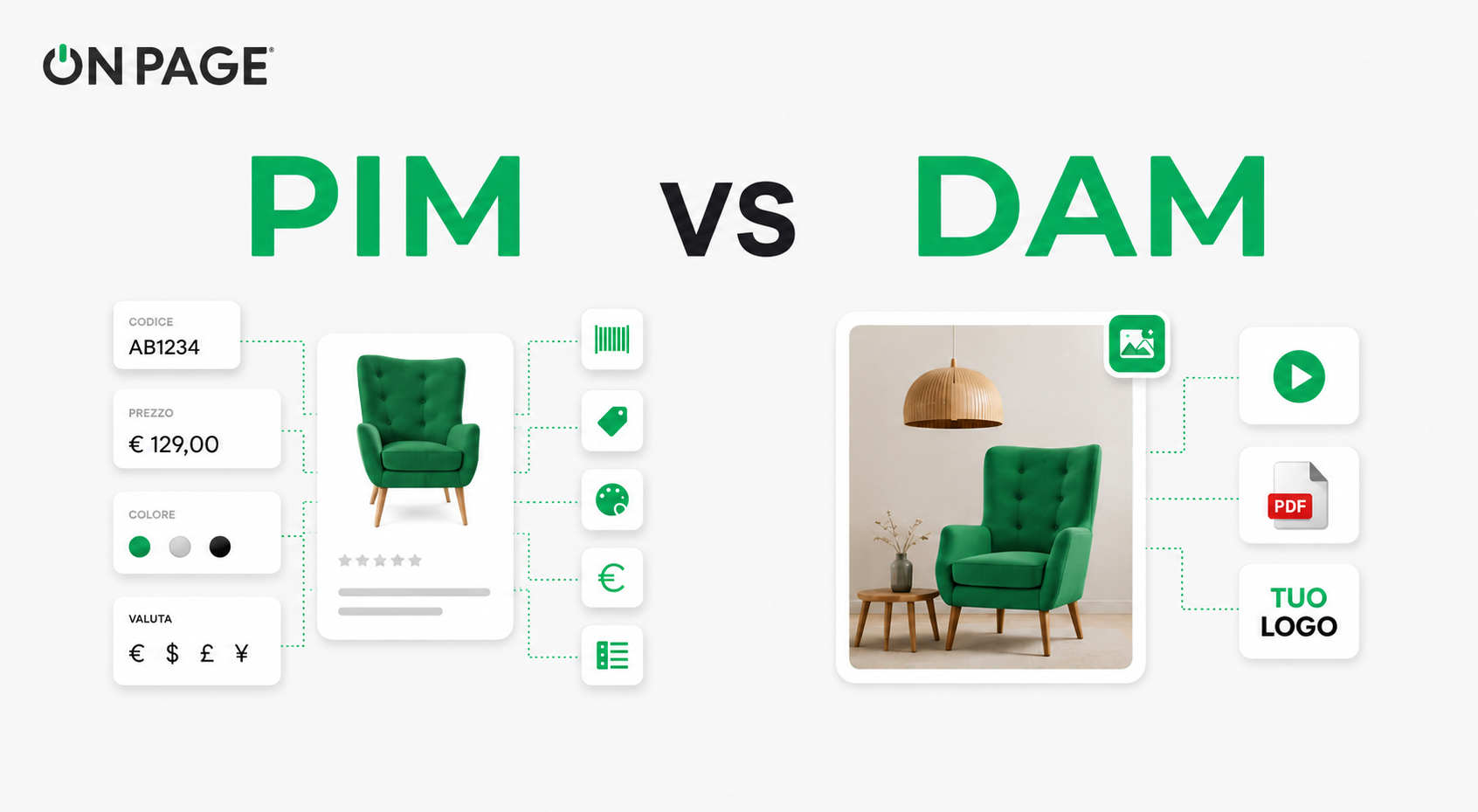
PIM is, literally, the brain of your product data. Imagine it as a massive, intelligent archive that collects, organizes, and enriches all the textual and technical information about what you sell.
Its job is to take raw data coming from the ERP (Enterprise Resource Planning system), which is usually sparse, dry, and not suitable for sales, and transform it into market-ready content.
In a PIM, you will find:
- Marketing descriptions in various languages.
- Technical specifications and measurements.
- EAN codes, SKUs, and weights.
- Product relationships (cross-selling and up-selling).
Implementing such a system is not just a technological upgrade but a strategic choice for those looking to seriously digitize their catalog. This concept is reinforced by SAEP ICT, which highlights how PIM is the key tool to ensure accurate data on every sales channel. Thanks to a PIM, marketing can enrich product sheets with storytelling, translations, and technical relationships that the ERP simply cannot manage
What is DAM (Digital Asset Management)?
DAM, on the other hand, is the place where all multimedia files (the “assets”) used to communicate the product and the company are stored.
Without a DAM, your files lead a scattered life between Dropbox, expired WeTransfer links, and slow local servers. With a DAM, every asset is cataloged with “tags” that make it traceable in a second.
In a DAM, you will find:
- PDF certifications and safety data sheets.
- High-resolution images (TIFF, JPG, PNG).
- Promotional videos and tutorials.
- Company logos and brand books.
PIM vs DAM: putting them in the ring
The question often arises: “If I have a PIM that holds photos, why do I need a DAM?” or vice versa. The truth is that, although both manage content, they do so for different purposes.
To resolve the long-standing PIM vs DAM debate and understand how to win the organization challenge, we have summarized the key points in this table:
| Feature | PIM (Product Information Management) | DAM (Digital Asset Management) |
| Primary Focus | Product data and text | Multimedia files and digital assets |
| Objective | Selling and informing correctly | Organizing and protecting the brand |
| Typical User | Marketing, eCommerce Manager, Sales | Designers, Social Media Managers, Agencies |
| Data Managed | SKUs, descriptions, translations, prices, technical data | Photos, videos, audio, logos, PDFs |
| Connections | Connected to ERP, CMS (Shopify, Magento, WordPress, Prestashop), InDesign, and sales channels | Connected to editing tools (like Adobe InDesign) |
Why they are not the same thing (the key PIM vs DAM difference)
The confusion arises from the fact that many PIM systems allow you to upload an image to associate it with a product. But beware: uploading a file does not mean managing it.
A PIM tells you that “product X has photo Y.” A DAM allows you to convert that photo Y into ten different formats with one click, control who has permission to download it, and verify that the usage license has not expired.
In short: PIM manages the “what,” DAM manages the “how it looks.”h2 The Problem with External Integrations
In the software market, most companies choose a PIM from one provider and a DAM from another. On paper, it seems like a great idea (I’ll take the best of both!), but in practice, you risk creating a small technological monster.
To make them communicate, you need to build bridges (called APIs) that are often:
- Expensive: they require hours of programming.
- Fragile: if one of the two software updates, the bridge risks collapsing.
- Slow: the transfer of heavy files between platforms can create bottlenecks.
This is where many marketing teams start regretting the old Excel sheets. But there is a simpler way.
The On Page® advantage: when DAM is native
This brings us to why On Page® plays in a league of its own.
Unlike many competitors who sell you a PIM and then tell you, “oh, if you want DAM, we need to connect this external software,” On Page® is built with a native DAM.
What does “Native” mean in plain language?
It means there are no cables, no bridges, and no cumbersome integrations. The DAM and PIM are two sides of the same coin, built on the same architecture.
The benefits of an integrated DAM (Stress-Free):
- Instant Synchronization: If you upload a new product photo to the On Page® DAM, it is immediately available for the print catalog, the eCommerce site, and the agents’ app. No need to upload twice.
- Total Order: You can link one asset (e.g., a technical datasheet) to hundreds of different products in one go. If the datasheet changes, you update it once, and it changes everywhere.
- No Hidden Costs: You don’t have to pay two different software subscriptions or spend thousands of Euros on consulting to make them communicate.
It’s the difference between having one remote for the TV, one for the decoder, and one for the audio, and having a smartphone that controls everything with a single touch. Less friction, more speed.
How to know if you need PIM, DAM (or both)
If you are still undecided, try this short test. You need both (and you need them to work together) if:
- Time-to-Market is vital: If publishing a new product takes you weeks because the data is in one place and the photos are in another, you are losing money.
- You manage a multi-language catalog: Translating texts is a PIM job, but ensuring that the graphic layout with the correct photos is properly displayed requires an integrated DAM.
- You sell on multiple channels: If you sell on Amazon, your website, and through distributors, you need to send precise data (PIM) and correctly formatted images for each platform (DAM).
Stop searching, start managing
In a world where speed is everything, you cannot afford to waste hours searching for files or manually correcting errors between technical data sheets and images.
Understanding the PIM vs DAM difference is the first step to regaining control of your work. But the decisive second step is choosing a solution that doesn’t complicate your life with endless integrations.
With On Page®, you get the power of an advanced PIM and the flexibility of a native DAM in a single platform. Your data is back in order, your assets are always ready, and you can finally return to doing what you do best: marketing.
Want to see how automation can transform the way you work?
Discover how On Page® works and book a free demo.

Centralize, update, publish. Without starting from scratch every time.
Discover how On Page® centralizes and synchronizes product information.