
Jordana Dambros
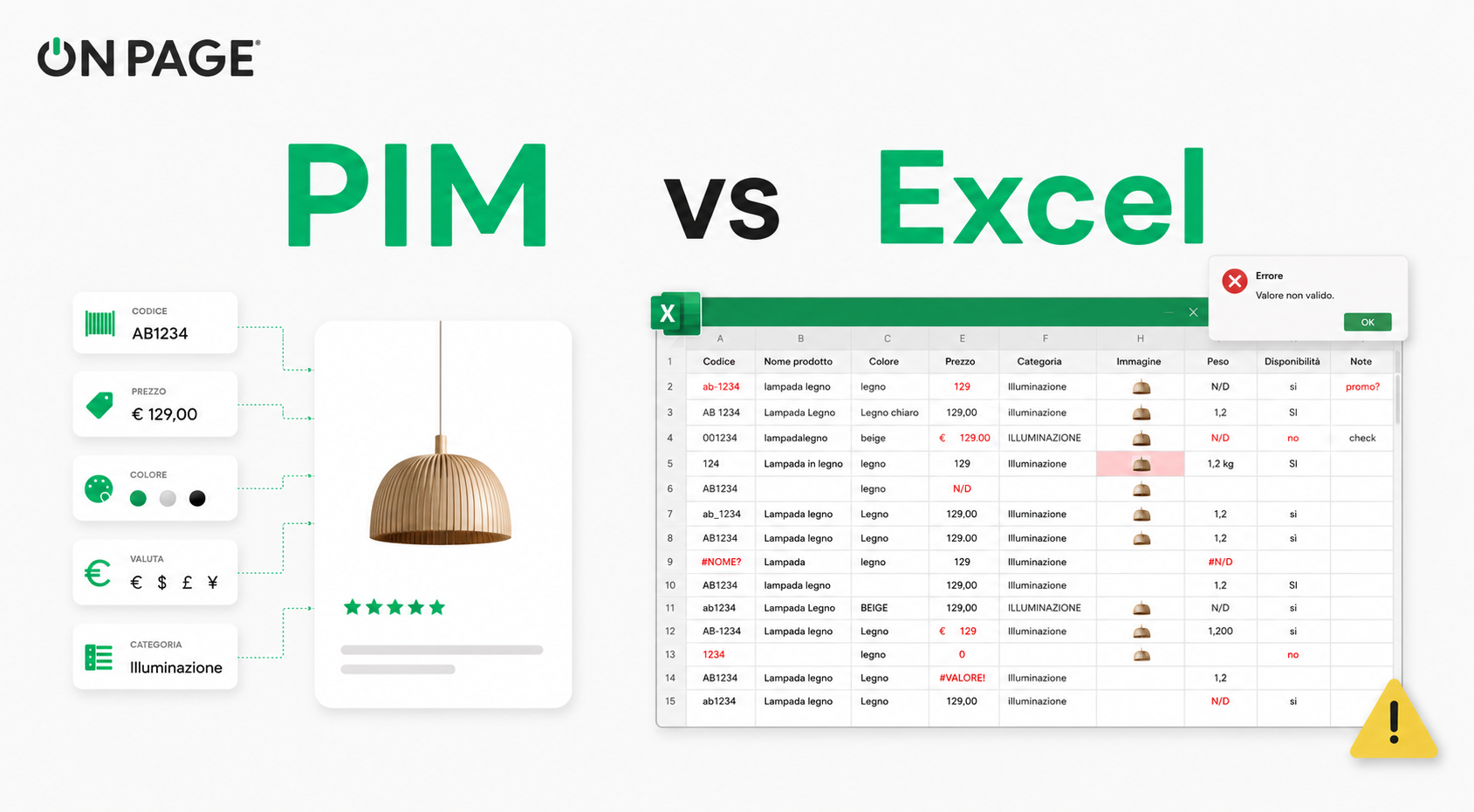
In this article, we’re making an honest comparison: PIM vs Excel. We’ll look at where the convenience of the spreadsheet ends and where real business begins.
Let’s be honest: if you work in B2B marketing or manufacturing, Excel is probably your comfort blanket. Everyone knows how to use it, it appears to cost nothing, and it lets you manage a bit of everything with total freedom. But here’s the problem: in 2026, trying to manage a multi-channel catalog on a spreadsheet is like attempting to race a Grand Prix in a basic economy car.
The numbers don’t lie: a properly detailed product data sheet boosts conversions by 30-50% and halves time-to-market. It’s no surprise that the market for PIM (Product Information Management) is literally exploding: from $20.95 billion in 2025 to $25.22 billion in 2026, with a projection of $121.48 billion by 2035.
Source: Precedence Research
Why Compare PIM and Excel?
Excel is not “evil.” If you have just three products and only sell them locally, it works fine. But as your company grows, what was once an agile tool becomes a prison of rows and columns.
Excel product data management carries an enormous hidden cost. Poor quality product information costs companies an average of $12.9 million per year. At the same time, PIM adoption is growing due to the need to centralize data and respond to increasing risks from cyberattacks and stricter regulations.
Choosing between PIM and a spreadsheet is not a software challenge, but a strategic decision: do you want to keep patching holes, or do you want a system that drives your sales forward?
Emerging Limitations of Excel in Product Information Management
Errors and Lack of Control (The Reign of the Typo)
Human error is lurking around every corner, and Excel loves it. It seems that 88% of corporate spreadsheets contain errors. A comma instead of a period, a misspelled “kg,” a wild copy-paste… and poof: a wrong price or a missing certification ends up online. Excel doesn’t tell you, “Hey, this field is mandatory.” It lets you make mistakes in peace. And you pay the consequences.
Collaboration and Versions: Pure Chaos
I bet you have a folder full of files like: catalog_FINAL_rev_03_for_sergio.xlsx.
Who has the latest version? Who changed that SKU code? With Excel, collaboration is a pure gamble. There is no history, you don’t know who did what, and the risk of overwriting a colleague’s work is extremely high. It is the opposite of a single source of truth.
Scalability, Variants, and Multi-channel
As soon as you try to add variants (sizes, colors, materials) or sell on three different marketplaces in five languages, Excel raises the white flag. Managing multi-channel operations and searching for Excel alternatives becomes a physical necessity when you realize that transferring data from the file to the website takes entire weeks.
Spoiler: your marketing team should be focused on strategy, not data entry.
Evolution of PIM: Trends 2025–2026
Today’s PIM solutions are no longer just dusty databases. They have become true intelligent command centers.
- Cloud and Security: No more files saved on the desktop. Everything is centralized, secure, and accessible everywhere. With the increase in hacker attacks, keeping product information loose on Excel files is a risk you don’t want to take.
- AI and PXM (Product Experience Management): This is where it gets interesting. Modern PIMs use artificial intelligence to write descriptions, translate them, and even suggest how to improve photos to boost sales.
- Total Integration: PIM communicates with your ERP, your e-commerce platform, and your marketplaces. You change a piece of data once, and it ships it everywhere.
When to Switch from Excel to PIM. Signals That Excel is Holding You Back
If you recognize yourself in at least two of these points, it’s time to change:
- You have more than 500 products (or variants).
- Your team is losing their mind tracking too many versions of the same file.
- You sell abroad or on multiple platforms.
- Launching a new product is an agony that lasts for weeks.
Measurable Benefits: Less Stress, More Sales
Companies that switch to a serious PIM reduce time-to-market by 60-75%. This means reaching the market before the competition. Furthermore, the quality of information improves so much that customers trust you more and buy more willingly. Fewer errors equal fewer returns, which equals greater profit margins. Simple, right?
Evaluating Costs and ROI
Yes, a PIM costs more than an Office license. But how much is the time your team wastes costing you today? How much do the errors cost you? The ROI calculation isn’t about licenses; it’s about the freedom you give your marketing team to generate revenue instead of cleaning Excel cells.
Selection Criteria for SMEs and Structured Companies
To choose the most suitable PIM platform, you, as a marketing manager, should evaluate several criteria:
- Scalability: Cloud First. Choose a platform that grows with you. The cloud allows you to add users and features with a click, without having to reset everything or stop work every time the business expands.
- AI and Automation (Because Time is Precious). Ensure there is artificial intelligence to write descriptions automatically or analyze how customers are behaving. Less manual work for you means more time for strategy.
- Total Connection. A PIM is not an island: it must communicate with your management system (ERP), e-commerce site, and image archive (DAM). If systems communicate well, the information is always correct everywhere.
- Security and Control. Who can modify what? It is essential to be able to manage permissions and approval workflows, so you always know who has handled the data and you comply with regulations.
- Ease of Use. If the software is too complex, no one will use it. Look for an intuitive interface and good support. Even better if you can start with basic modules and add pieces over time.
- Vision for the Future. The world is moving towards AI and personalization. Choose a partner that isn’t stuck, but has a clear roadmap for the trends of the coming years.
PIM vs Excel, Which Path for Marketing?
We’ve reached the point: PIM vs Excel is not a war. Excel was an excellent companion on your journey, but if you want to play in the big leagues, it’s no longer enough. The chaos of shared files, typos in product sheets, and slow product launches are burdens your company can no longer afford.
A modern PIM gives you the control, automation, and the extra boost from AI that makes the difference between a mediocre catalog and one that drives massive sales.
Discover the Solution:If you are tired of struggling with Excel columns and want to finally see your product information work for you, explore PIM platforms like On Page®. It’s time to stop managing files and start creating memorable shopping experiences.

Centralize, update, publish. Without starting from scratch every time.
Discover how On Page® centralizes and synchronizes product information.